Don’t Get it Twisted: Barrel Twist Does Matter
Knowing the twist rate of your barrel is critical. It’s not just a number stamped on the side of the barrel. It directly affects bullet stability, bullet selection, and downrange performance, yet it’s often glossed over when people choose a rifle or build a new one. Understanding twist rate doesn’t require a physics degree; just a practical understanding of how it impacts precision shooting/hunting.
What Is Twist Rate?
Twist rate describes how fast your barrel spins the bullet as it travels down the bore.
It’s expressed as a ratio, like this:
- 1:7
- 1:8
- 1:9
- 1:10
This means one full rotation of the bullet for every X inches of barrel.
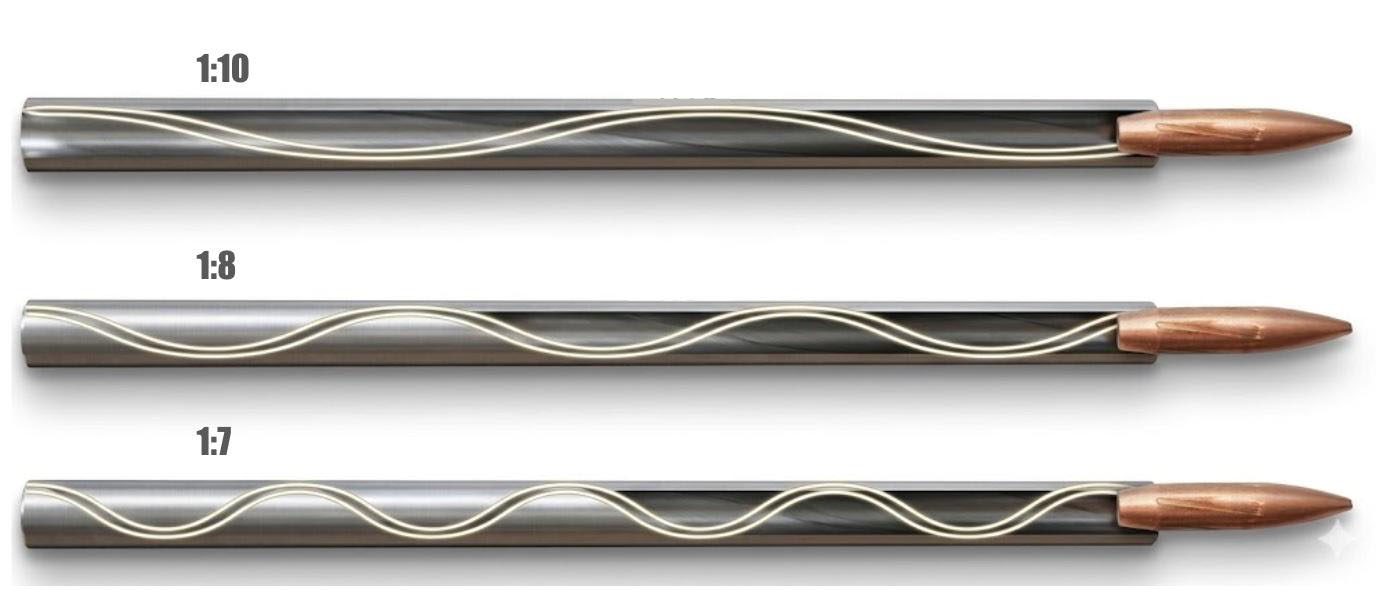
So:
- A 1:7 twist spins the bullet faster (The bullet spins one full rotation every 7 inches)
- A 1:10 twist spins the bullet slower (The bullet spins one full rotation every 10 inches)
So if you have a 1:10 twist and a 20” barrel, your bullet has completed two full rotations before exiting the bore.
Why does this matter? What’s the purpose of a faster or slower twist?
It's about stability, which creates better downrange performance (in all aspects).
Obviously, the smooth bore lead ball that was once used in muskets was more of a knuckle ball than anything. The only stability - if we can even call it that - came from the initial velocity of the projectile.
Downrange, that ball lost velocity very fast (which in turn sacrificed all of the little stability it had) and therefore was not very accurate. With the invention of rifling, firearms manufacturers began to understand that spinning the bullet created stability in the projectile. After that elongated bullets began to appear.
With elongated bullets came the need for controlled spin, and that’s where twist rate enters the conversation. Longer bullets are inherently harder to stabilize, which means they require a faster twist to keep them flying point-forward. If the twist is too slow, the bullet won't adequately stabilize, resulting in tumbling and poor accuracy. When the bullet is properly matched to the barrel’s twist rate, gyroscopic stability is achieved. That stability allows the bullet to retain velocity, resist wind, and behave predictably at distance.
In summary, for a given caliber, heavier bullets are typically longer, and longer bullets require a faster twist rate to remain gyroscopically stable.
Bullet Weight and Twist Rate (The Practical View)
Here’s a rule of thumb for common hunting/precision cartridges:
.223 / 5.56
- 1:7 → 77–85 gr (ideal for modern precision)
- 1:8 → 69–77 gr (great all-around)
- 1:9 → 55–69 gr (marginal)
6mm (6 Creedmoor, .243)
- 1:7.5 or 1:8 → 105–115 gr (modern standard)
- Slower twists struggle with long 110–115 gr bullets
6.5mm (6.5 Creedmoor, PRC)
- 1:8 → 130–156 gr (perfect)
- No reason to use lighter projectiles
7mm (7 Rem Mag, 7 PRC)
- 1:8 or 1:8.5 → 160–195 gr bullets
- Old 1:9.5 barrels and limit bullet choice
.30 Cal
- 1:10 → 168–215 gr (safe and versatile)
- 1:11 or slower seriously limits bullet selection
So, if your rifle is not shooting very well, try a different bullet weight! Your rifle just may not be set up to shoot your bullet well! A quick example: I like horse trading! I needed to rent my neighbors’ skid steer loader, and he had a 25-06 that didn’t shoot well. This rifle had seen it all. It had been kept in the truck for years, and the old wooden stock had swollen horribly because he’d lost it in the woods for an entire winter.
After dremeling out the stock to get it free floating again, checking all torque specs and putting a new optic on it, I sighted it in at 100 yards.
I couldn’t get this rifle to shoot under 3” groups with the 110 grain bullets my neighbor gave me. I stopped at the local sporting goods store and grabbed some 90 grain bullets for the slow 1:10 twist of this .25-06. I not only had this rifle shooting 1” groups at 100, but it was shooting consistently out to the 700 yard targets I had set up.
Stability Isn’t Binary
This part matters.
Bullets aren’t just “stable” or “unstable.” There’s a stability margin.
- Marginal stability = random flyers
- Cold weather = reduced stability from more air density = more drag
- Higher altitude = increased stability from less air density = less drag
- Velocity loss downrange matters
A bullet that barely stabilizes at the muzzle may:
- Lose stability past 600–800 yards
- Produce increasingly inconsistent group sizes at distance
- Perform inconsistently on game
This is why twist rate matters more for long-range hunting than short-range shooting.
Twist Rate and Precision Shooting
In precision shooting, consistency is king.
A properly stabilized bullet will:
- Track predictably
- Hold BC better
- Respond more consistently to wind
- Fly point-forward at extended distances
This directly affects:
- Vertical spread
- Wind calls
- First-round impacts
A marginal twist rate means the bullet can misbehave downrange, no matter how good your ballistic solver is.
The solver assumes stable flight. Garbage in, garbage out.
Twist Rate and Hunting (Where It Really Matters)
Let’s be clear: Hunting bullets obey physics.
With the proper twist rate, longer, heavier, high-BC bullets:
- Buck the wind better
- Retain velocity longer
- Penetrate more consistently
- Perform better at distance
But only if they’re stabilized.
A bullet that yaws or destabilizes:
- Loses accuracy
- Loses penetration efficiency
- Can behave unpredictably down range and in tissue
Ethical kills depend on repeatable accuracy, not theoretical energy numbers.
Can You Over-Stabilize a Bullet?
Short answer: No… but yes.
In my opinion, the faster-the better! That’s like asking if throwing a football with a tighter spiral is bad?
However, when shooting thinner jacketed bullets, I have witnessed bullets come apart mid flight. Basically, there was too much friction. The bullet couldn’t handle that fast of a twist. In this scenario, I needed to change bullets or order another barrel with a slower twist rate if I was adamant about shooting that particular bullet. So I would call this a bullet problem, not a twist rate problem.
What does a faster twist rate give you?
- Flexibility in bullet choice
- Better cold-weather performance
- More stability margin
- Future-proofing (meaning - as bullets get longer, you don’t get left behind or have to buy yet another barrel)
Why Faster Twist Rates Are the New Standard
Manufacturers didn’t randomly decide to begin rifling their bores with tighter twist rates.
They responded to:
- Longer bullets
- Higher BC designs
- Suppressor use
- Extended-range shooting
- Better understanding of external ballistics
That’s why you now see:
- 6mm barrels at 1:7.5
- 7mm barrels at 1:8
- .30 cal barrels rarely slower than 1:10
It’s progress rather than a trend.
Choosing the Right Twist Rate (Simple Method)
Here’s the simplest way to choose:
- Select a bullet
- Choose a twist that comfortably stabilizes the longest bullet
- Ignore everything else
If you’re on the fence, go faster.
There is almost no downside, and plenty of upside.
Summary: Down to the brass tacks
Twist rate:
- Controls bullet stability
- Determines bullet compatibility
- Affects precision and consistency
- Matters more at distance
- Matters more with modern bullets
- Matters more for ethical hunting
Faster twist rates don’t make you a better shooter, but they can remove limitations.
And removing limitations is how you stack the odds in your favor.
Because whether you’re dialing for steel or settling a crosshair behind an animal’s shoulder, the goal is the same:
Shots on target.